Frequently Asked Questions (FAQ)
Straight-vane secondary mounts
(last updated Jan. 7, 2023)
Should I use a 3-vane or 4-vane spider?
My secondary mirror isn't one of your sizes. Can I still use a Protostar holder?
Can I swap different sizes of secondary mirrors in the same spider?
How many mounting lugs are on each spider vane?
Can I order mounts with a special overhang dimension?
Can I order just a spider or a holder by itself?
Why does the website use mostly 3D rendered product images?
Antidew heater questions
Should I get the anti-dew heater option?
What kind of power supply is required for the anti-dew heater?
How do I attach power wires for the antidew heater?
Built-in offset questions
Should I use a 3-vane or 4-vane spider?
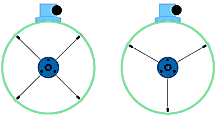 The choice between a 3-vane or 4-vane spider is largely an aesthetic preference, and the consequence of your decision will be the pattern of the diffraction spikes that emanate from bright objects. A 4-vane spider produces four brighter spikes. A 3-vane spider produces six, dimmer, spikes. A 3-vane spider is a good choice for telescope tubes up to about 18 inches in diameter.
3-vane spiders are the best choice for most applications, but they are also a particularly good choice for planetary and lunar observers. The brightness of the spikes is inversely proportional to the viewing magnification. So, at the high powers typical of planetary observation the spikes disappear, and the view is more "refractor like".
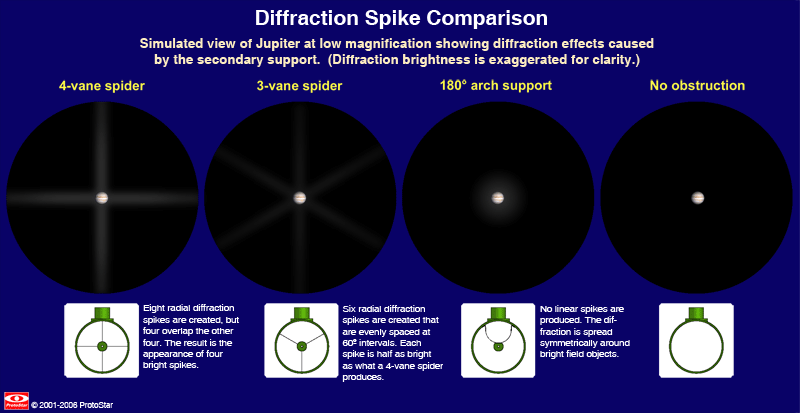 4-vane spiders are a good choice for large truss-style telescopes. Typical upper cage designs use four metal strut pipes around the outside of the cage assembly, and these struts are frequently the only place to attach the spider to.
4-vane spiders are also a better choice for photographic telescopes. Having fewer spikes in the photograph is usually preferable to having dimmer ones. An aesthetic preference for four spikes is also a perfectly defendable reason for choosing a 4-vane spider.
My secondary mirror isn't one of your sizes. Can I still use a Protostar holder?
Yes. We can make a spider and holder for any size secondary mirror.
Can I swap different sizes of secondary mirrors in the same spider?
Sometimes, but often it isn't possible. The central stem on the secondary holder varies in diameter from 1/4" up to 3/4" depending on the secondary mirror size, so they're not all interchangeable. Also, the overhang dimension changes with each secondary holder size, and there usually isn't sufficient axial travel in the holder adjustment to accommodate two sizes at once without moving the position of the spider.
How many mounting lugs are on each spider vane?
The number of lugs on each vane has been determined through testing and experience, and depends on the size of the secondary mirror and the tube size.
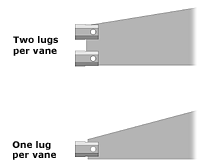
Mirror holder size |
Number of lugs
|
0.75" to 2.48" |
One lug for all tube sizes. |
bigger than 2.48" |
Two lugs for all tube sizes. |
Can I order mounts with a special overhang dimension?
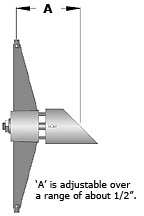 As a general rule, this isn't possible. The overhang ('A' dimension in the graphic) is predetermined by our tooling. However, you do not have to drill the spider mounting holes in your tube with high precision, as there is about 1/2" of total adjustment travel (i.e., +/- 1/4") to accommodate for measuring tolerances and other variables.
The exception to this are the spiders designed to be direct replacements for commercial telescopes. Those are designed with an 'A' dimension that matches the scope so no new holes in the tube are required.
Why are there lead-times for secondary mountings?
We can typically ship secondary mounts in 1-3 weeks of your order.
Can I order just a spider or a holder by itself?
Yes, we sell spider and mirror holder subassemblies separately, but be aware that these two components work together to allow for collimation. (The collimation screws are in the spider hub, while the clutch disk and semi-flexible shaft are part of the mirror holder.) In other words, one part without the other probably won't work unless you have a custom design in mind. For the same reason, our holders will not work in other manufacturer's spider designs. If you need either a spider or holder to replace a damaged component, please contact us for details.
I don't want to use an Allen wrench for collimation. Can I replace the collimation adjusting screws with finger-operated thumbscrews?
Off-the-shelf bolt solutions for thumbscrew adjustment are to be strictly avoided. The problem is that standard bolts of sufficient length do not have threads fully formed along the entire bolt length. If you turn the screws in too much, the non-threaded portion of the bolt shaft will begin to engage the brass thread inserts in the spider hub. Once this happens, the entire spider is usually ruined, as you can't get the bolt back out without spinning out the thread insert. The insert and the bolt bind together.
The other problem is that most plastic thumbscrew heads have a diameter that's too large, and they will partially protruding into the light path. This is a particular problem for the 1.83" and 2.60" sizes, since the spider hub is nearly the same size as the secondary mirror.
We offer custom-designed finger adjusting screws as an option. They are fully-threaded aluminum shafts with precision ground tips and custom heads designed for your fingers in the dark. See our options page for more details.
Why does the website use mostly 3D rendered product images?
Many of our products are very black and don't photograph well. The 3D rendered images show far more detail. That said, we do include a few traditional photographed images to show that the real product matches the virtual one closely.
Should I get the anti-dew heater option?
The antidew heater is recommended for observers who frequently stay up well past midnight when dew is most likely to form, or live in a region where dew is a more persistent problem. Also, secondary mirrors in open truss-style cages tend to dew up more frequently than closed tube telescopes.
What kind of power supply is required for the the anti-dew heater?
Any DC power source with a voltage of 13 volts or less will work with the antidew heater. The heater can be used at full voltage to clear dew that has been allowed to form, but only about 1/3 to 1/2 of this voltage is required to keep dew from forming. To lengthen the battery life, we recommend a solid-state controller like the Kendrick Controller to throttle down the power consumption of the antidew heater.
How do I attach power wires for the antidew heater?
There are several ways to attach power wires to the two conductive vanes. It can be done externally or hidden inside the tube. More information can be found in the instruction manual for heated spiders.
Should I "offset" my spider?
Offsetting the secondary is the practice of shifting the secondary mirror away from the focuser by a small amount so that its geometric center is no longer in the center of the tube. From a purely optical standpoint, offsetting has no effect on optical quality, collimation, or vignetting. Incorporating offset will do no harm, but there is no optical benefit either. The only consequence of not offsetting is that the optical axis (i.e., where the scope's mirror is pointed) will not be perfectly parallel the tube's center axis.
If you have a Newtonian mounted a German equatorial mount (GEM) then offsetting will ensure the optical axis is parallel with the telescope tube's axis. Depending on the GOTO system, this can potentially reduce slewing/pointing errors. For Dobsonian mounted telescopes - even those with a GOTO system - having the two axis parallel is not important.